Do You Need an Environmental Impact Assessment in Nigeria? A Complete Guide for Developers
Adeola Omolewa · 30 July 2026 · 7 min read
If you're planning a development project in Nigeria; residential, commercial, industrial, or infrastructure; one of the first compliance questions you'll face is whether you need an Environmental Impact Assessment in…
Contents
- What Is an Environmental Impact Assessment?
- Is an Environmental Impact Assessment Mandatory in Nigeria?
- Which Projects Need an EIA in Nigeria?
- What Are the Steps in the EIA Process in Nigeria?
- How Long Does an EIA Approval Take in Nigeria?
- How Much Does an EIA Cost in Nigeria?
- Common Challenges Developers Face During the EIA Process
- What Happens If You Skip It?
- Why Work With an EIA Consultant?
- How Litedares Africa Can Help
- Frequently Asked Questions
If you're planning a development project in Nigeria; residential, commercial, industrial, or infrastructure; one of the first compliance questions you'll face is whether you need an Environmental Impact Assessment in Nigeria before you break ground. Get this wrong, and you risk delays, penalties, or a stalled project. This guide answers the questions developers ask most.
What Is an Environmental Impact Assessment?
An Environmental Impact Assessment (EIA) is a structured process used to identify, predict, and evaluate how a proposed project could affect the environment, communities, and public health before construction begins. In practice, it's a study followed by a report and regulatory review that helps decision-makers weigh a project's economic benefits against its environmental and social costs and put safeguards in place where needed.
Is an Environmental Impact Assessment Mandatory in Nigeria?
Yes. Nigeria's Environmental Impact Assessment Act (Cap E12) makes EIA a legal requirement for projects likely to have a significant effect on the environment. The Federal Ministry of Environment administers the EIA process, while the National Environmental Standards and Regulations Enforcement Agency (NESREA) is responsible for enforcing environmental compliance more broadly. This is because Nigeria operates a federal system; individual states may also have their own environmental agencies or ministries whose input is required during the process, so requirements can vary slightly depending on where your project is located.
Commencing construction before EIA approval is issued is not permitted, and enforcement action for non-compliance is a real and growing risk as regulatory oversight tightens across Nigeria's industrial and real estate corridors.
Which Projects Need an EIA in Nigeria?
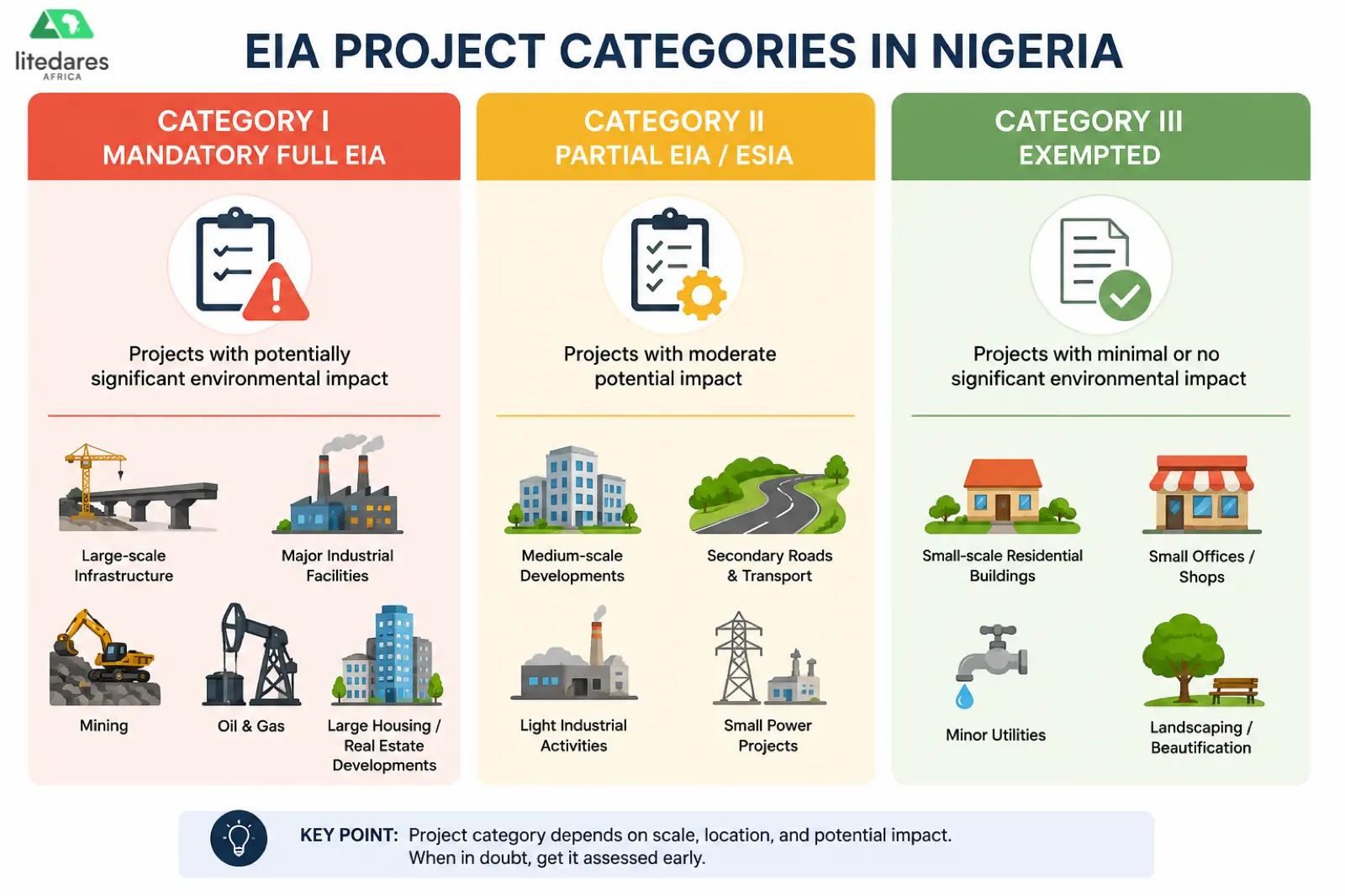
Nigeria's EIA framework sorts projects into three categories, and knowing which one applies is often the first thing developers get wrong:
- Category I: Mandatory Full EIA. Projects with potentially significant environmental impact: large-scale infrastructure, mining, oil & gas, major industrial facilities, and sizeable housing or real estate developments typically fall here.
- Category II: Partial EIA / Environmental and Social Impact Assessment (ESIA). Projects with moderate potential impact, where a lighter-touch but still formal assessment is required.
- Category III: Exempted. Projects considered to have minimal or no significant environmental impact, which generally don't require a full EIA process.
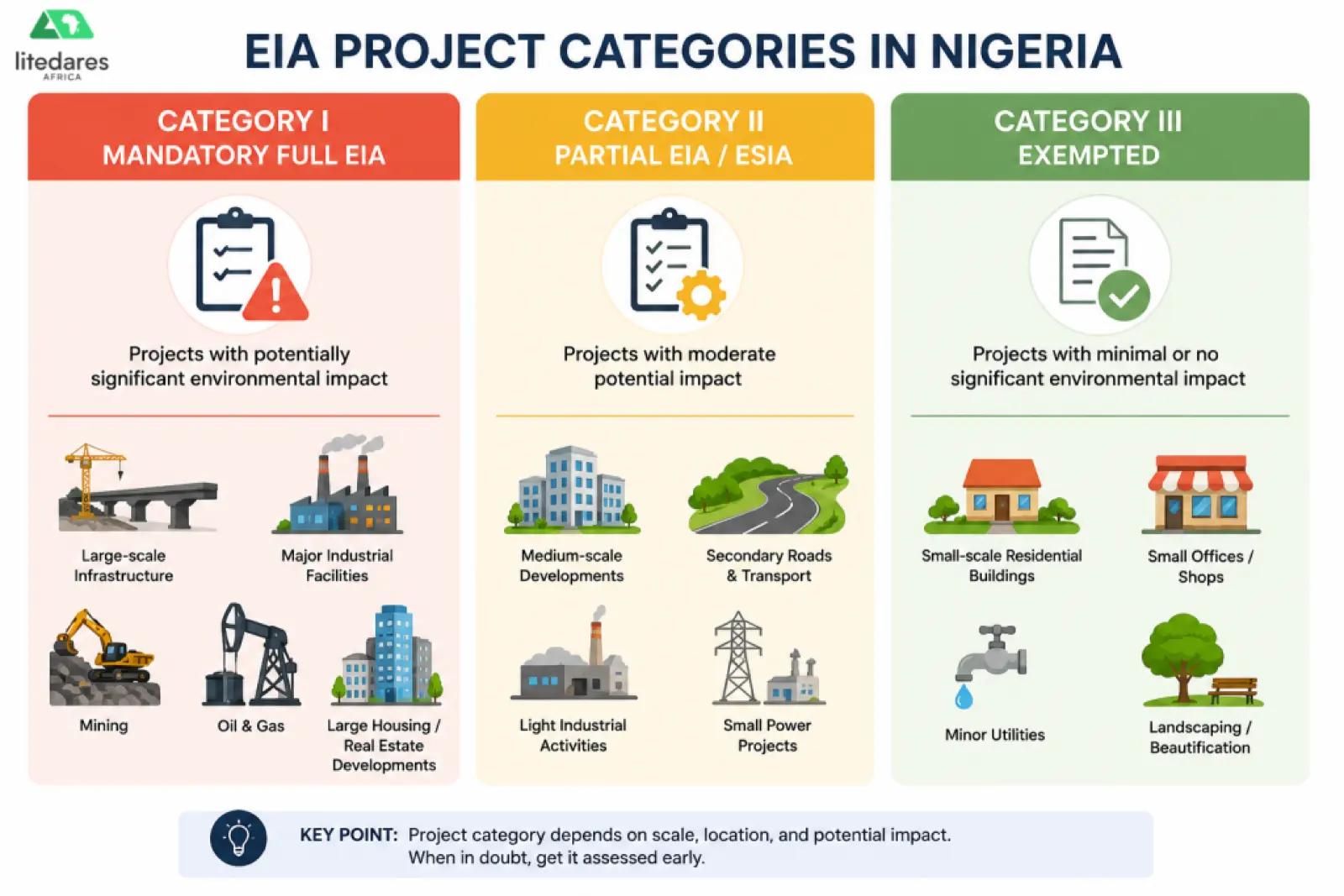
In practice, housing estates, factories, roads, power projects, and mining or oil & gas infrastructure are among the project types most commonly required to undergo an EIA, depending on their scale and location. If you're unsure which category your project falls into, that classification step is exactly where an experienced consultant earns their fee; misclassifying a project is one of the most common (and costly) early mistakes.
What Are the Steps in the EIA Process in Nigeria?
The EIA process in Nigeria follows a fairly consistent sequence, regardless of project type:
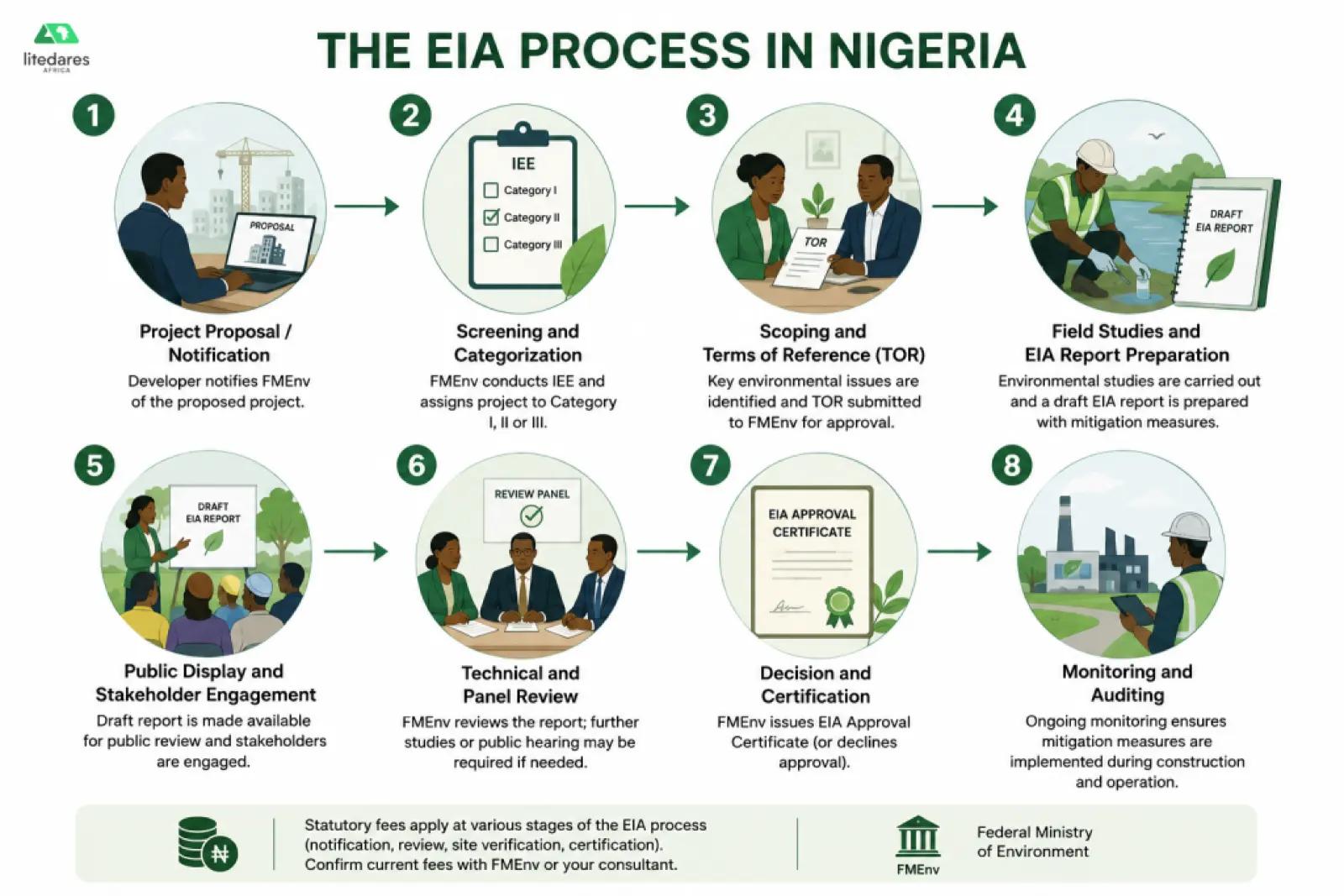
- Project proposal/notification. The developer notifies the Federal Ministry of Environment (FMEnv) of the proposed project, typically through a formal notification form.
- Screening and categorization. FMEnv conducts an Initial Environmental Examination (IEE) and assigns the project to Category I, II, or III, issuing a Screening Report.
- Scoping and Terms of Reference (TOR). The developer, often through an environmental consultant, identifies the key environmental issues to be studied and submits a TOR for FMEnv's approval.
- Field studies and EIA report preparation. Environmental consultants carry out field studies, air, water, soil, ecology, and socio-economic assessments and compile findings, along with proposed mitigation measures, into a draft EIA report.
- Public display and stakeholder engagement. The draft report is made available for public review, and affected communities and stakeholders are formally engaged as part of the process.
- Technical and panel review. FMEnv reviews the draft report and, depending on the project, may convene a review panel; further studies or a public hearing may be requested if the agency isn't satisfied.
- Decision and certification. Once FMEnv is satisfied, it issues an EIA Approval Certificate (or, in some cases, declines approval).
- Monitoring and auditing. Approved projects remain subject to ongoing environmental monitoring to confirm the agreed mitigation measures are actually being followed through construction and operation.
Various statutory fees apply at different stages of this process (notification, review, site verification, and certification), and the applicable amounts can change, so it's worth confirming current fees directly with FMEnv or your consultant rather than relying on a fixed figure.
How Long Does an EIA Approval Take in Nigeria?
EIA approval timelines are commonly cited in the range of roughly 30 to 90 working days, around one to three months, though this varies significantly based on project complexity, the completeness and quality of your documentation, and how quickly regulatory review and any required public consultation stages move. Projects with thorough baseline data and well-documented community engagement from the outset tend to move faster; incomplete submissions are the most common cause of delay.
How Much Does an EIA Cost in Nigeria?
Costs vary widely depending on project category, scale, location, and the depth of environmental and social baseline studies required; a Category II residential development and a Category I mining or oil & gas project will have very different cost profiles. Rather than quote a fixed figure that won't hold across project types, the most reliable approach is a scoping conversation with a consultant who can assess your specific project and give you a grounded estimate.
Common Challenges Developers Face During the EIA Process
A few recurring issues account for most of the delays and rework developers run into:
- Incomplete or vague Terms of Reference. A TOR that doesn't clearly scope the environmental issues relevant to the project tends to bounce back and forth with FMEnv, adding weeks before field studies even start.
- Jurisdictional overlap. Because Nigeria operates a federal system, state environmental agencies can have their own requirements alongside FMEnv's; developers who only plan for the federal process sometimes get caught out by state-level steps.
- Weak or late stakeholder engagement. Public participation isn't a formality; a public forum or panel review that surfaces unaddressed community concerns can send a project back for further studies.
- Treating EIA as a late-stage formality. Projects that only start the EIA process once construction is imminent, rather than during early planning, lose the most time, since screening, scoping, and field studies all have to happen before ground can be broken.
- Underestimating documentation standards. Draft reports with thin baseline data (air, water, soil, ecology, and socio-economic) are a common reason FMEnv requests further studies rather than approving on first review.
Most of these are avoidable with early planning and an experienced consultant managing the process, which is exactly where the cost of getting it right upfront tends to be far lower than the cost of delays later.
What Happens If You Skip It?
Beyond the legal exposure, skipping or rushing an EIA creates practical risk: financiers and DFIs increasingly require evidence of environmental compliance before releasing funds, communities and regulators can and do halt projects over undocumented impacts, and retrofitting environmental safeguards after construction has started is far more expensive than planning for them upfront.
Why Work With an EIA Consultant?
Given how many of the delays above come down to process management rather than the science itself, most developers find it faster and cheaper overall to bring in an experienced EIA consultant rather than managing the process in-house. Here's what a good consultant actually adds:
- Accurate categorization from the start. Misclassifying a project, assuming Category III when it's really Category II, for example, is one of the costliest early mistakes. A consultant who works across project types spots this immediately.
- A TOR that FMEnv approves faster. A well-scoped Terms of Reference, built from experience with what reviewers actually look for, avoids the back-and-forth that adds weeks to a timeline.
- Rigorous baseline data, the first time. Thin field studies are the single biggest reason draft reports get sent back for further work. A consultant with the right technical team (air, water, soil, ecology, and socio-economic) builds documentation that holds up on first review.
- Navigating federal and state requirements together. Because EIA touches both FMEnv and, in many cases, state environmental agencies, a consultant who understands both layers prevents the jurisdictional surprises that catch solo developers out.
- Stakeholder engagement that's actually credible. Public forums and panel reviews go smoother when community engagement has been genuinely and visibly conducted, not just documented as a formality; this is a specific skill, not an afterthought.
- Faster overall timeline, despite the added step. Counterintuitively, paying for a consultant upfront is usually what keeps a project on the 30–90 day end of the range rather than sliding into months of rework.
- Ongoing compliance support. EIA approval isn't the finish line; monitoring and auditing continue through construction and operation, and a consultant who stays engaged post-approval reduces the risk of compliance issues surfacing later.
This is exactly the gap Litedares Africa is built to close.
How Litedares Africa Can Help
Litedares Africa supports developers across [Nigeria and wider Africa] through the full EIA journey, from initial screening and category determination through baseline environmental and social studies to preparing and submitting documentation for regulatory review. BOOK A FREE CONSULTATION or CONTACT US
Frequently Asked Questions
Is an Environmental Impact Assessment legally required in Nigeria?
Yes. Under the EIA Act, projects likely to significantly affect the environment must undergo an EIA before construction begins.
Which government body oversees EIA in Nigeria?
The Federal Ministry of Environment administers the EIA process, with NESREA responsible for broader environmental enforcement, and state-level environmental agencies also involved depending on project location.
How long does an EIA take in Nigeria?
Approval timelines are commonly cited at around 30–90 working days, depending on project complexity and documentation quality.
Can I start construction before EIA approval?
No. Construction should not begin before EIA approval is obtained.